Direct Exchange Geothermal Makes Modern Home Heating Simple and Waterless
What Is Direct Exchange Geothermal?
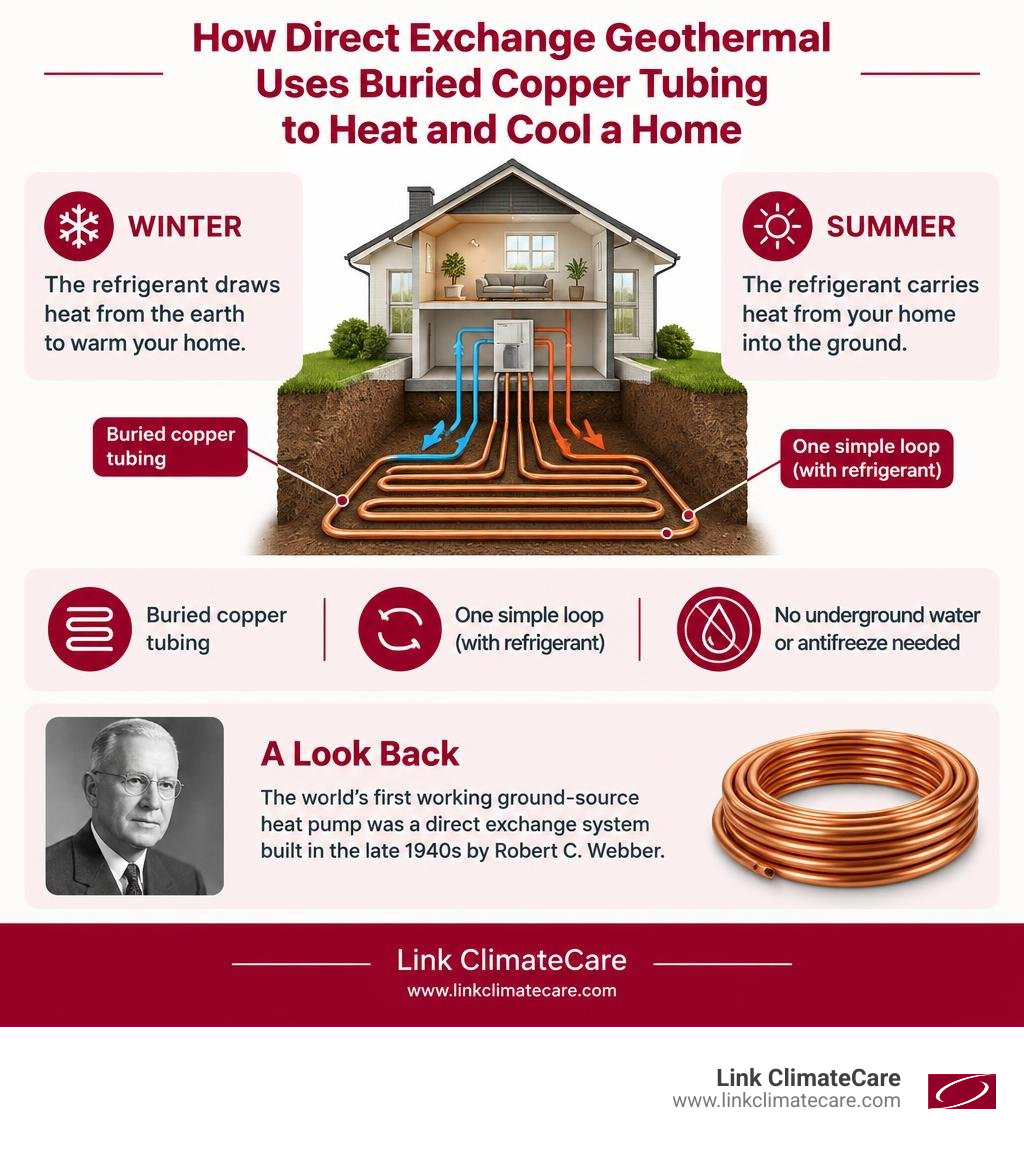
Direct exchange geothermal is a heat pump system that moves refrigerant through copper tubing buried in the ground. In winter, the refrigerant draws heat from the earth to warm your home. In summer, it carries heat from your home into the ground. Unlike many geothermal systems, it needs no separate underground water or antifreeze loop.
That simpler loop can reduce the space and equipment needed for installation. But whether it suits your home depends on your heating and cooling needs, soil conditions, yard space, and local rules.
This guide explains how direct exchange geothermal works and what homeowners should consider before choosing it.
Understanding Direct Exchange Geothermal Systems and Their History
When people imagine ground-source heating, they often picture massive networks of plastic pipes pumping hundreds of gallons of water and glycol across their property. Direct exchange technology takes a far leaner approach.
The concept is not new. The world's very first working ground-source heat pump was actually a direct exchange system built in the late 1940s by an inventive American named Robert C. Webber. After accidentally burning his hand on the hot discharge pipe of a deep freezer, Webber routed the hot refrigerant through copper tubing submerged in water to warm his cellar, eventually expanding the concept to bury copper coils in his yard.
Over the decades, the industry adopted several names for this approach. You might hear technicians refer to it as Direct Geoexchange (DGX), direct expansion (DX), or simply "waterless geothermal." Regardless of the label, the core definition found on any comprehensive Direct exchange geothermal heat pump reference remains identical: it is a closed-loop system where the working refrigerant circulates directly through ground-embedded heat exchange tubing.
While market forecasts in 2016 suggested that only a minority of future installations would utilize DX technology compared to traditional water-to-air systems, modern direct exchange remains a brilliant, highly compact option for property owners seeking sustainable geothermal heating on smaller residential lots.
How Direct Exchange Geothermal Differs from Traditional Water-Loop Systems
Traditional ground-source heat pumps rely on an intermediate step. They circulate a water-and-antifreeze mixture through long runs of high-density polyethylene (HDPE) pipe buried outdoors. Once that fluid absorbs thermal energy from the earth, it enters the home, where an internal heat exchanger transfers that warmth to the unit's refrigerant circuit.
Direct exchange systems eliminate that middleman entirely. By pumping the refrigerant directly into the ground through narrow, highly conductive copper tubing, DX systems bypass the secondary fluid loop, the circulating water pumps, and the secondary internal heat exchanger.

Eliminating that secondary fluid loop delivers distinct operational differences:
- No Intermediate Thermal Resistance: In a water-based system, heat must move through the soil, cross the thick plastic pipe wall, warm the water-antifreeze mixture, flow indoors, and then pass through a titanium or stainless-steel heat exchanger into the refrigerant. With DX, heat passes through thin-walled copper straight into the boiling refrigerant.
- Lower Parasitic Energy Losses: Water-source systems require continuous circulation pumps to drive heavy fluid through hundreds of feet of plastic pipe. DX systems rely solely on the compressor's pumping power, saving electrical overhead.
- Significantly Smaller Footprint: Because copper conducts thermal energy roughly 1,000 times better than plastic, a direct exchange loop requires significantly shorter trench or borehole lengths to achieve the same heating capacity.
| Feature / Metric | Direct Exchange (DX / DGX) | Traditional Water-to-Air Closed Loop |
|---|---|---|
| Ground Loop Material | Seamless, annealed copper tubing | High-density polyethylene (HDPE) |
| Circulating Medium | EPA-approved refrigerant | Water and glycol/antifreeze solution |
| Intermediate Heat Exchanger | None (direct contact) | Coaxial or brazed-plate heat exchanger |
| Circulation Pumps | None required | Dedicated water loop circulator pumps |
| Typical Pipe Depths | Shallow trenches or 50–100 ft boreholes | Deep trenches or 150–300+ ft boreholes |
| Primary Testing Standard | AHRI 870 | ISO 13256-1 |
The Thermodynamic Vapor Compression Cycle in Heating and Cooling Modes
A direct exchange system harnesses the physical laws of phase change—the massive amount of thermal energy absorbed or released when a chemical shifts between liquid and vapor states.
Heating Mode
During winter home heating, the system operates as follows:
- Evaporation in the Earth: Cold, low-pressure liquid refrigerant is sent out into the underground copper loop. Because the surrounding soil remains at a stable temperature (typically 7°C to 12°C / 45°F to 54°F year-round), heat flows naturally into the colder copper tubes. The refrigerant boils and evaporates into a low-temperature vapor.
- Compression: The vapor returns indoors to the compressor, which pressurizes the gas. Compressing the gas concentrates the absorbed heat, driving its temperature up significantly.
- Indoor Condensation: The superheated vapor passes through the indoor air coil. Your home's ductwork draws cool indoor air across this coil, absorbing the heat and distributing cozy air through your vents. As it releases its warmth, the refrigerant condenses back into a high-pressure liquid.
- Expansion: The liquid passes through a thermal expansion valve, dropping its pressure and temperature before heading back underground to repeat the cycle.
Cooling Mode
When summer arrives, an internal reversing valve switches the flow to deliver crisp, efficient home cooling:
- Indoor Evaporation: The indoor coil becomes the evaporator. Warm indoor air passes over the coil, boiling the cool liquid refrigerant and chilling the indoor air while pulling out excess humidity.
- Compression & Reversal: The compressor boosts the pressure of the warm refrigerant vapor and directs it outdoors into the buried copper ground loop.
- Underground Condensation: The subterranean copper lines now act as a condenser. The hot vapor releases its thermal load into the cooler surrounding earth, turning back into a cool liquid ready to cycle through the expansion valve again.
Copper Ground Loop Configurations and Engineering Considerations
The primary reason direct exchange systems operate so efficiently with short loop lengths is copper. Copper has an exceptional thermal conductivity rating (around 400 W/m·K) compared to HDPE plastic (roughly 0.4 W/m·K). This allows rapid, uninterrupted heat transfer across thin tubing walls.
However, burying metal in the earth requires careful engineering. Soil conditions vary wildly, and ground containing high moisture, stray electrical currents, or acidic pH levels can cause galvanic corrosion if left unprotected.
To ensure decades of trouble-free operation, environmental and natural resource agencies—such as those detailed by the Geothermal Heating and Cooling | NC DEQ guidelines—mandate specific protective measures. Professional installers assess local soil resistivity and apply cathodic protection, such as connecting buried sacrificial magnesium or zinc anodes to the copper manifold. These sacrificial anodes naturally corrode in place of the copper, preserving the pressure boundary of the ground loop for its full design life.
Installing Direct Exchange Geothermal Loops: Vertical, Diagonal, and Horizontal Options
Direct exchange ground circuits are flexible and adapt well to challenging property layouts. Because total loop runs rarely need to exceed 100 linear feet per ton of capacity, installers can choose between three main layouts:
- Vertical Boreholes: Vertical loops utilize narrow holes drilled 50 to 100 feet deep. This is ideal for urban or suburban homes with compact yards where excavation space is tight.
- Diagonal (Radial) Drilling: Multiple boreholes are drilled outwards at angles from a single small excavation pit, resembling the ribs of an umbrella. This configuration provides substantial underground heat exchange surface while disturbing only a few square feet of lawn.
- Horizontal Trenches: Where yard space permits, trenches are excavated roughly 4 to 6 feet deep. Copper tubing is laid flat or in overlapping slinky configurations along the trench floor before being backfilled.
Protecting local groundwater is paramount during any geothermal installation. For vertical and diagonal boreholes, technicians seal the entire depth using bottom-up pressure grouting with thermally enhanced bentonite grout. This seals the borehole from surface runoff, ensures solid thermal contact between the copper and the earth, and maintains strict aquifer isolation.
System Sizing and Multi-Stage Capacity for Modern Homes
Direct exchange systems are commonly manufactured in capacities ranging from 2 tons (7.03 kW) up to 6 tons (21.10 kW). For larger homes or light commercial properties, multiple modular units can be paired together to handle higher heating and cooling loads.
Modern units pair this subterranean efficiency with advanced, multi-stage or variable-speed compressors. Rather than kicking on at 100% capacity whenever the thermostat calls, these modern heat pumps run at lower, quieter speeds for the vast majority of the year. This matches your home's minute-by-minute heat loss, keeps indoor temperatures remarkably steady, and lowers electrical draw during mild shoulder seasons.
Efficiency Benchmarks and Regulatory Permitting Guidelines
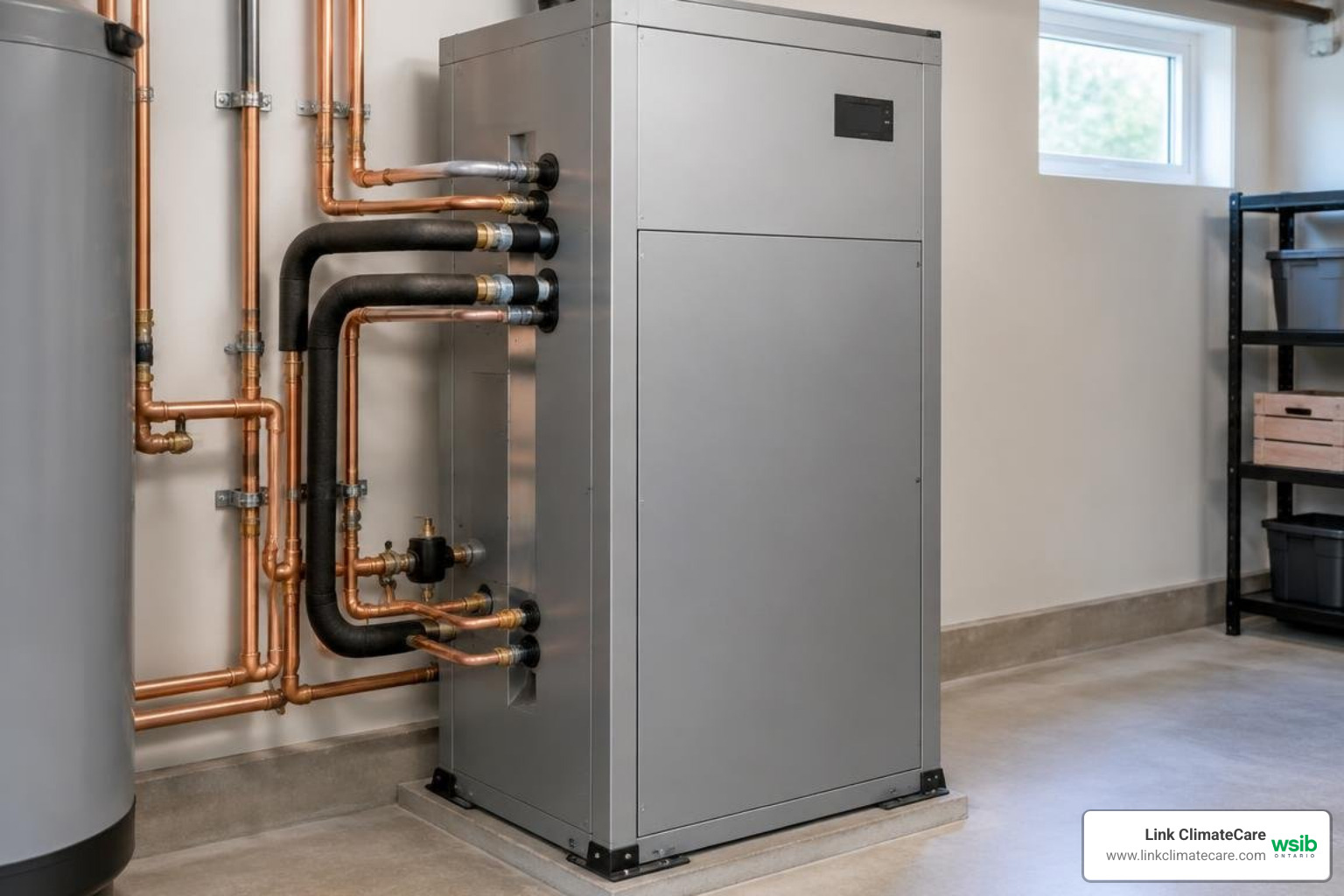
Because direct exchange systems use refrigerant directly in the ground loop rather than water, they are tested and certified under specialized standards. The Air-Conditioning, Heating, and Refrigeration Institute evaluates DX units using the AHRI 870 standard (contrasting with the ISO 13256 standards applied to water-to-air and water-to-water units).
To earn the gold standard of energy efficiency, systems must meet rigorous thresholds outlined in the Geothermal Heat Pumps Key Product Criteria | ENERGY STAR guidelines:
- Direct Geoexchange (DGX): Minimum Energy Efficiency Ratio (EER) of 16.0 and minimum Coefficient of Performance (COP) of 3.6.
- Closed-Loop Water-to-Air: Minimum EER of 17.1 and minimum COP of 3.6.
- Open-Loop Water-to-Air: Minimum EER of 21.1 and minimum COP of 4.1.
A COP of 3.6 means that for every single unit of electrical energy consumed by the compressor, the system delivers 3.6 units of clean heat into your home—representing an astounding 360% operational efficiency.
From a regulatory standpoint, direct exchange systems offer clear permitting advantages over open-loop alternatives. Because they do not extract, pump, or discharge groundwater, state environmental bodies—such as those publishing the Geothermal Heat Pump Systems construction guidelines—classify closed-loop systems outside of heavy Class V industrial injection well rules. While local building permits and proper isolation distances from existing water wells, septic fields, and property lines must always be observed, DX loops avoid ongoing water withdrawal permits and discharge monitoring.
Maintenance and Long-Term System Protection
While direct exchange systems remove the hassle of testing antifreeze mixtures or rebuilding failed water circulator pumps, they are precision refrigeration appliances that depend on specialized care.
To protect your investment and maintain peak performance, professional annual maintenance should focus on several key areas:
- Refrigerant Charge Verification: Because the ground loop holds a closed refrigerant charge, technicians use electronic leak detection and digital pressure gauges to confirm that operating pressures and subcooling/superheat values remain within manufacturer specifications.
- Cathodic Protection Monitoring: Testing the electrical potential between the buried copper tubing and the sacrificial anode ensures that soil conditions have not exhausted the anode's protective reserves.
- Brazed Joint and Manifold Inspection: Verifying the mechanical integrity of indoor headers, service valves, and line sets prevents minor vibration from developing into micro-leaks.
- Airflow and Filtration Balance: Keeping the indoor air coil spotless and blower motor calibrated ensures the heat pulled from the earth is delivered efficiently into your living spaces.
Because handling pressurized refrigerants and testing underground cathodic protection circuits requires dedicated licensing and diagnostic tools, homeowners should always leave inspections and repairs to certified HVAC technicians rather than attempting DIY servicing.
Frequently Asked Questions About Direct Exchange Systems
Why are copper tubes preferred over HDPE plastic in direct exchange loops?
Copper is the standard material for DX systems due to its high thermal conductivity, structural strength, and compatibility with high-pressure refrigerants. High-density polyethylene (HDPE) lacks the thermal transfer rates needed for compact boiling circuits and cannot safely handle the high operating pressures of modern refrigerants. Copper can be brazed reliably, bent around obstacles, and provides rapid heat exchange across minimal surface area.
How much can homeowners save compared to conventional HVAC systems?
According to data from the U.S. Environmental Protection Agency (EPA) and natural resource agencies, ground-source heat pump systems routinely save homeowners 40 to 60 percent on their heating and cooling costs compared to conventional electric baseboards, propane furnaces, and standard central air conditioners. By eliminating combustion fuels and extracting the majority of home warmth directly from the soil, operating costs plummet.
Are direct exchange systems classified as injection wells under state regulations?
No. Because direct exchange systems circulate refrigerant in a permanently sealed, closed loop of copper tubing without withdrawing or injecting water into subterranean aquifers, they are not regulated as Class V injection wells under federal and state Underground Injection Control (UIC) rules. They are classified as closed-loop heat exchangers, simplifying the local building permit process compared to open-loop pump-and-dump wells.
Conclusion
Direct exchange geothermal proves that cutting your carbon footprint and lowering utility bills doesn't require sprawling, water-filled trenches across your yard. By transferring heat straight between the earth and your home using high-efficiency copper tubing, DX systems deliver exceptional comfort with a smaller installation footprint.
Deciding whether a direct exchange or traditional water-loop configuration fits your property requires expert load calculations, careful soil evaluation, and experienced local installation. At Link ClimateCare, we bring decades of hands-on expertise to homeowners across Beaverton, Lindsay, Peterborough, and the entire Kawartha Lakes region. Backed by our 100% satisfaction guarantee and 24/7 emergency response, our licensed technicians are ready to help you navigate your journey to reliable, year-round comfort.
Ready to see how ground-source energy can transform your home? Take a moment to explore our comprehensive guide to geothermal heating ten common questions answered or get in touch with our team today for a tailored home assessment!